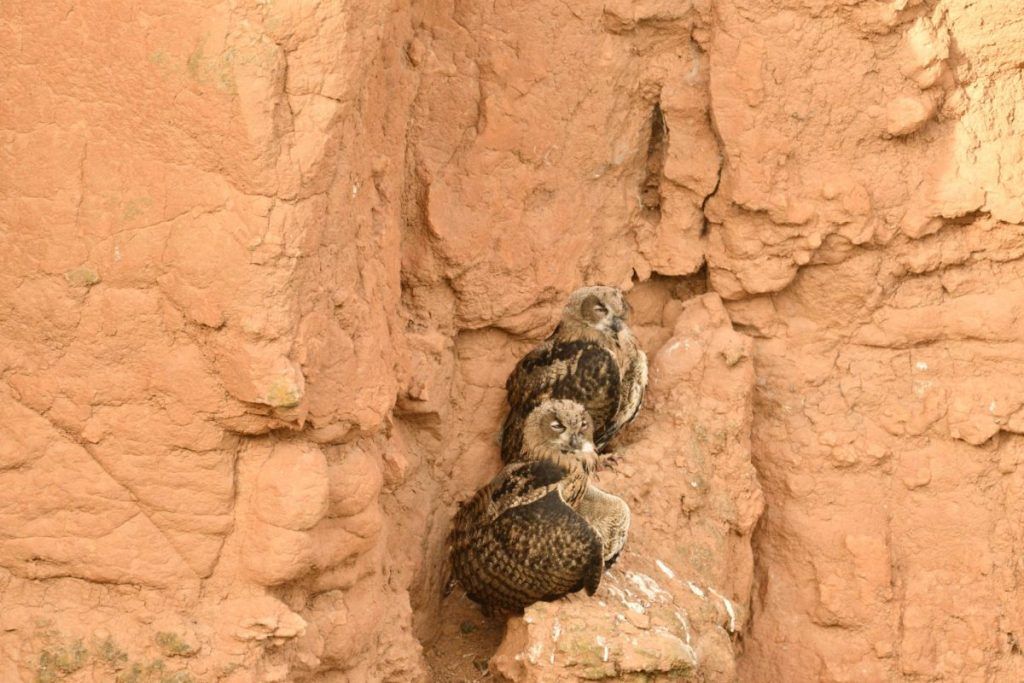
It is not easy to see the king of the night in broad daylight. The eagle owls They are birds of prey, it's true, but nocturnal birds of prey. They are the kings of stealth and darkness. That's why I was so surprised when a few months ago, at the beginning of summer, I came across several eagle owl chicks along with their parents. For a few days, I was able to observe these powerful birds of prey on their rocky perches as they scanned their territory and learned their parents' hunting techniques. Would you like to learn more about these beautiful birds?

Who would have told me that on one of my walks around the city where I live I would come across The Night Raptor par excellence? If someone asks us, what is the most well-known and representative nocturnal bird of prey, we would almost all immediately think of the eagle owl. Well, yes, there I was, on the cliffs and small crags that line the Henares River, on a cool June morning. The sun had just risen, and I only had my binoculars. It was a scouting trip, to see what small birds I could find on the banks and cliffs of the river.
Suddenly I saw the silhouette of something large flying over the cliff in front of me, about 400 meters away. I couldn't identify it, not even with binoculars, although I did spot some lighter spots on the rocks, which appeared to be nests or perches. Automatically, given the size of the bird, the location, and the time of day, I thought I had found a falcon perch. My fevered mind quickly imagined the sighting of a peregrine.Would it be possible that he had found them so easily?
Well, no. It wasn't a peregrine falcon flying over the cliff. When I got closer to identify the bird in question and discovered my mistake, I was much happier. It wasn't a peregrine falcon (ooooh!), but I had discovered the innkeeper of a eagle owl!
Could it be possible? After searching for nocturnal birds of prey in various regions of the Iberian Peninsula, I had almost accidentally stumbled upon the grand prize: the eagle owl, the king of the night.
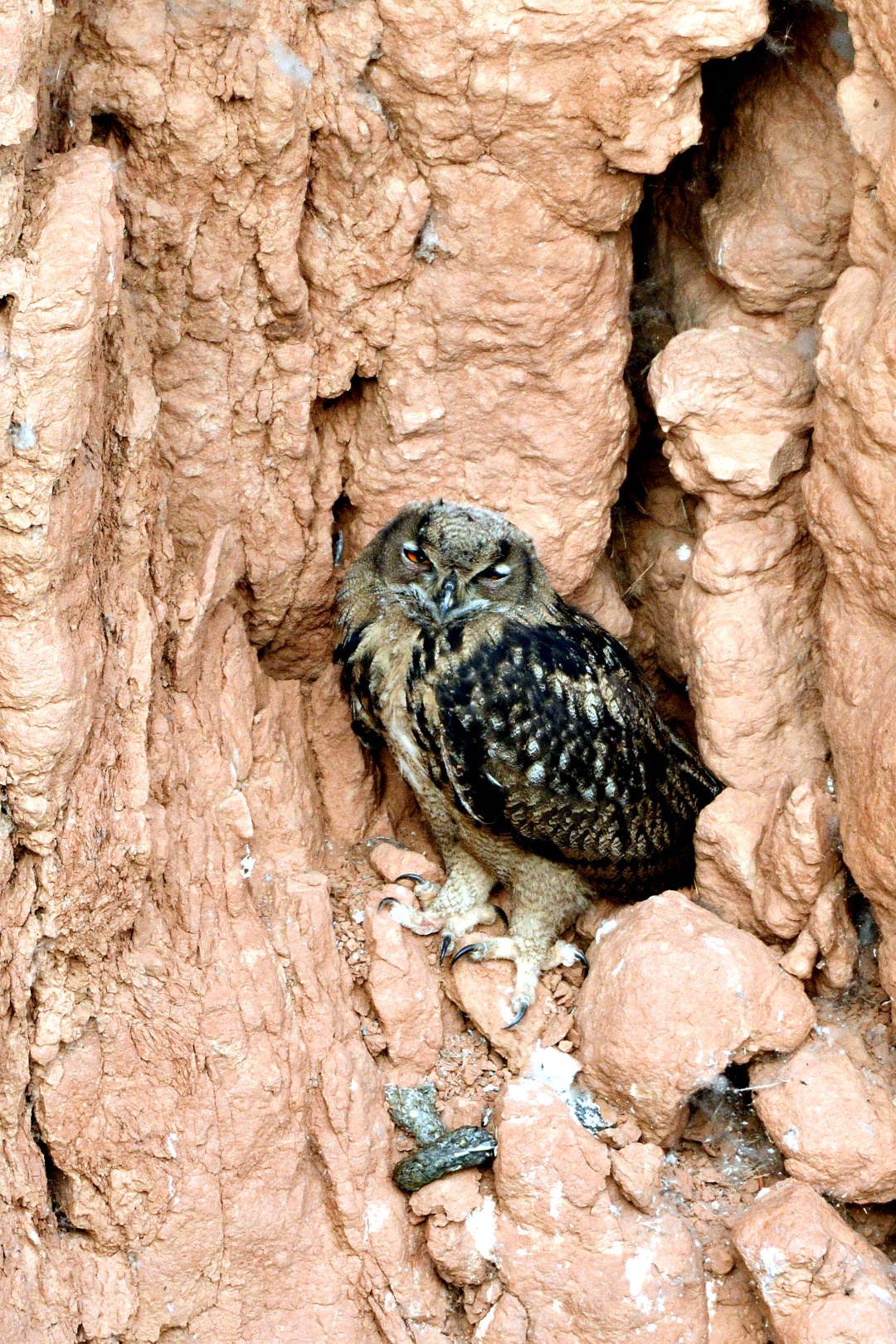 Identifying it is no mystery and it is not possible to make a mistake. It is an unmistakable birdStarting with their heads, owls display a kind of "ears," which are actually crests. Their bright orange eyes and curved black beak are also striking.
Their plumage is not easy to describe. There is a wide variety of shades, from the blackest feathers to the whitish tones, including brown, ochre, and gray. As a general rule, we can say that the dorsal area of the wings is darker, while the breast usually has lighter plumage. The leonine patterns on the plumage are also very spectacular and help to identify without a doubt that what we have before us is the largest nocturnal bird of prey on the European continent: the eagle owl.
It can range from 60 and 70 cm in height, a wingspan between 1.5 and 1.9 meters and a weight up to 3.5 kgIts song (howl) is also very characteristic and can be heard regularly during the mating season, throughout the winter.
At this point, it's worth mentioning how special their feathers are, which give them one of their greatest characteristics: their ability to hunt silently at night. Eagle owls are fabulous hunters. They have exceptional eyesight and spectacular hearing. Both senses help them locate their prey (rabbits, mice, voles, etc.) on the ground with enviable precision. So before even launching from their perch, the owl already knows how fast and at what angle to take off to hunt their prey. Few animals have such a hunting success rate as high as that of the eagle owl.
Like any other nocturnal bird of prey, eagle owls are not easy to locate, as their activity primarily occurs at night. But that doesn't mean they are elusive or that there are few specimens. On the Iberian Peninsula, the eagle owl is widespread in all kinds of places, from large, isolated cliffs to rocky outcrops and deep forests. They have even established themselves in industrial areas around large cities, using cranes, chimneys, and tall towers as vantage points from which they monitor urban rodent populations.
In #Fotogario We continue searching for stories... And that search sometimes brings us surprises like this morning's. A nest with 5 eagle owls (male, female and 3 chicks) when in fact we were looking for mushrooms... (and we found 5 Rolexes) (published in Facebook).
We can find populations of eagle owls distributed throughout Europe, Asia, and North Africa. In the Iberian Peninsula, they are widely distributed throughout all regions except the Cantabrian coast and the two archipelagos. This species does not migrate, except for some populations in northern Europe. Nor do they usually stray far from the area where they were born when they become independent from their parents.
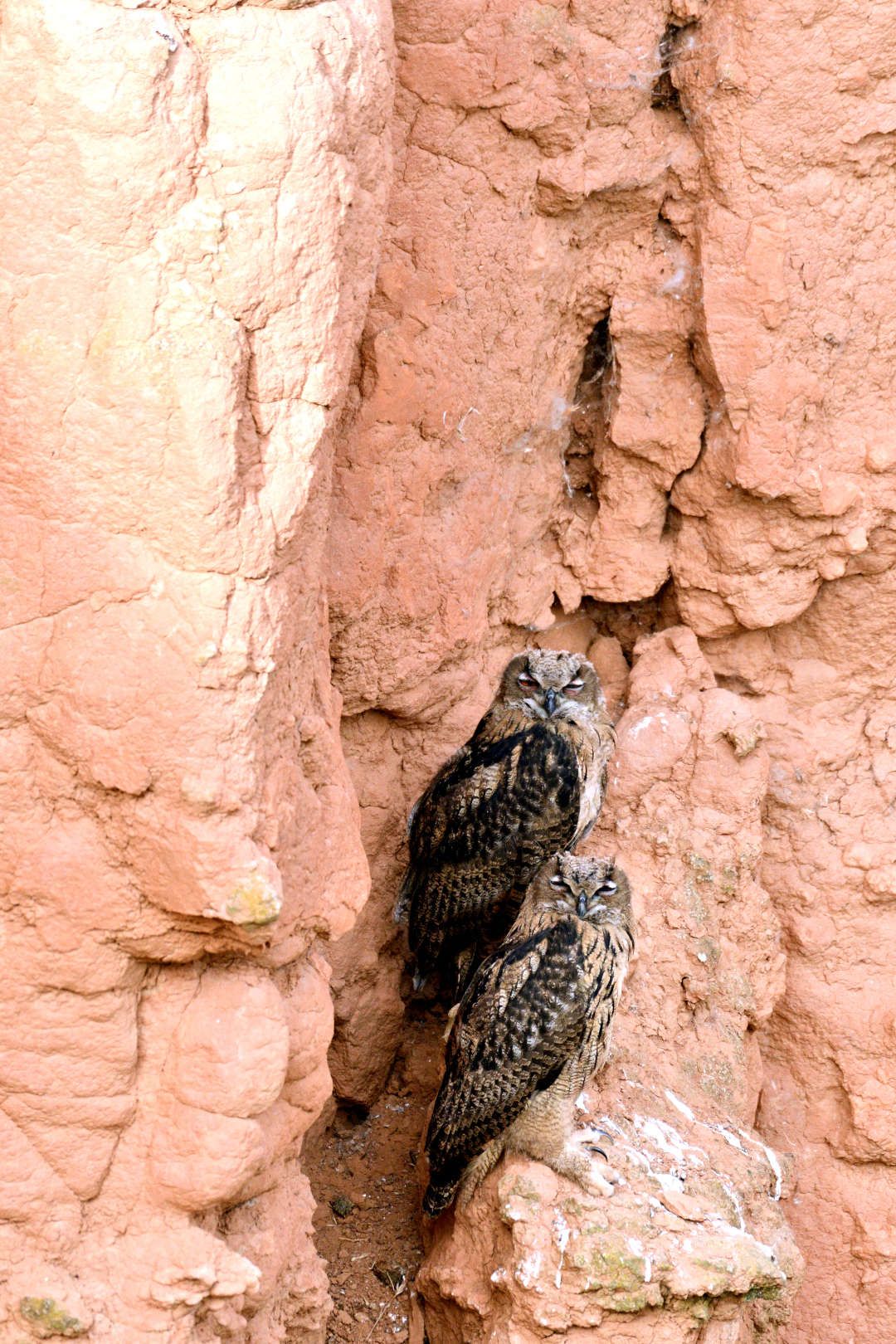 The eagle owl is a super predator, such as wolves, lynxes, and large diurnal birds of prey. Its favorite food is rabbits, and in some places it competes fiercely with the Iberian lynx for prey. But it also welcomes rodents, amphibians, other birds, and even the chicks of other raptors. That's why I found two adults (a male and a female) and their three well-developed chicks on some cliffs outside the city where I live. These cliffs are located on the banks of the Henares River, in an area where rabbit populations have recently skyrocketed. For adult Eurasian eagle-owls, it's the perfect place for several reasons:
At the end of autumn it begins its wedding season (in mating season). The males become "audible" and their hoot can be heard throughout the winter. Egg-laying occurs between January and February. In the case I encountered, I was able to observe up to three different chicks. The female usually incubates them for a little over a month, and once they hatch, they are fed by both parents for another two months. They then begin their first solo flights to learn hunting techniques, although their parents feed them for another month, at which point they leave the nest and look for a new location, staying close to their parents' territory.
For many years the eagle owl was a bird included in the national books of endangered species. In recent years, environmental awareness policies have been taking effect and the populations of this bird of prey have been recovering. Today the main threat to the eagle owl is the expansion of the human being. Power lines, the expansion of urban areas and the destruction of their ecosystems. Another major threat to these birds is the diseases that directly affect the rabbit populationsLike the fox or the Iberian lynx, eagle owls are severely affected when their main food source disappears due to diseases such as myxomatosis.
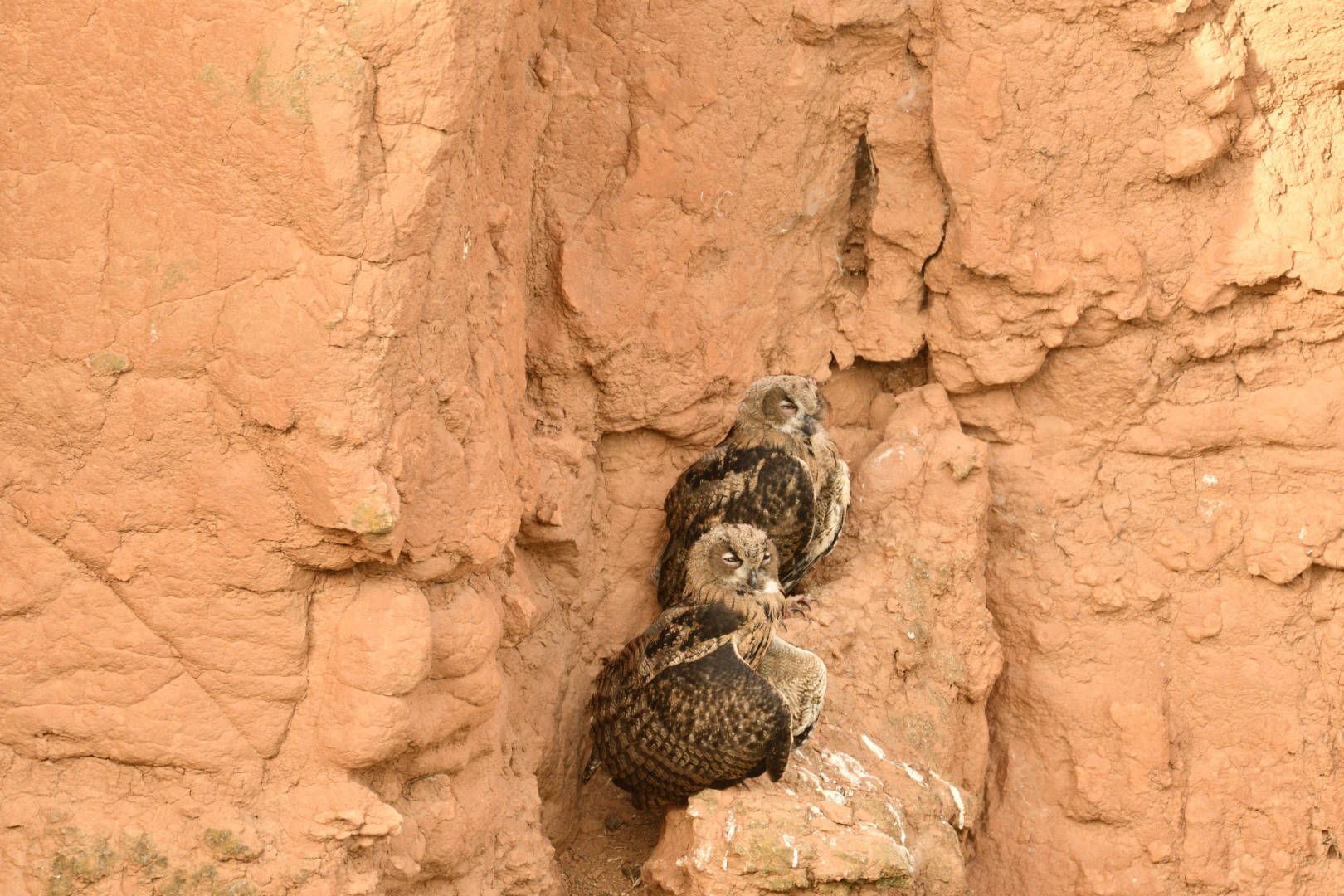
Guys, it was a real surprise for me to stumble upon these five eagle owls a few months ago. At this time of year, the chicks will have already left these perches to seek other, more hidden and protected places to spend the day. At night, they will go out to hunt, controlling a territory of several dozen square kilometers. But I'm sure that from time to time they will return to these cliffs, on the banks of the Henares River, especially at the beginning of the year, to teach the new generations of chicks their hunting techniques and how to navigate a habitat they completely dominate, being the great superpredators among the nocturnal birds of prey, the kings of the night.
If you want to see these chicks in action, don't miss this video of the Fotogario's YouTube channel:
Greetings, friends.