In this series of articles that we are dedicating to the birds of prey of the Iberian PeninsulaSooner or later, we were bound to encounter the "average" birds. That is, those birds of prey that don't stand out for their size, speed, agility, diet, or habitat. common buzzard It's one of those "run-of-the-mill" birds of prey. But it's precisely this characteristic that gives it great advantages.

If you have followed the previous articles you will know that a few months ago I told you about the golden eagle, one of the largest and most majestic birds of prey in the Peninsula. Both the photos of "la Real" and the common goshawk and of the common buzzard, were taken in a hide on my trip to the Sierra de Andújar in January 2022.
That's why the photos in this article (as well as those in the previous ones) are so good. The birds of prey seem to pose for my lens, partly because I'm well hidden (and silent) in a hide, and in large part, because we have previously given them a small contribution of food.
The fact is that today I want to talk to you about common buzzard, also known as buzzard either common buzzardThe buzzard is one of those birds of prey that doesn't really stand out for anything. This very characteristic is what allows it to adapt to different environments and surroundings and what has led to its widespread populations across the European continent.
Its success lies in its lack of specialization. It is a medium-sized bird of prey, with a height that does not exceed the 60 cm, and a wingspan that does not exceed the 140 cmAt this size, it adapts to a multitude of environments and is capable of reproducing in a wide variety of environments and climates.
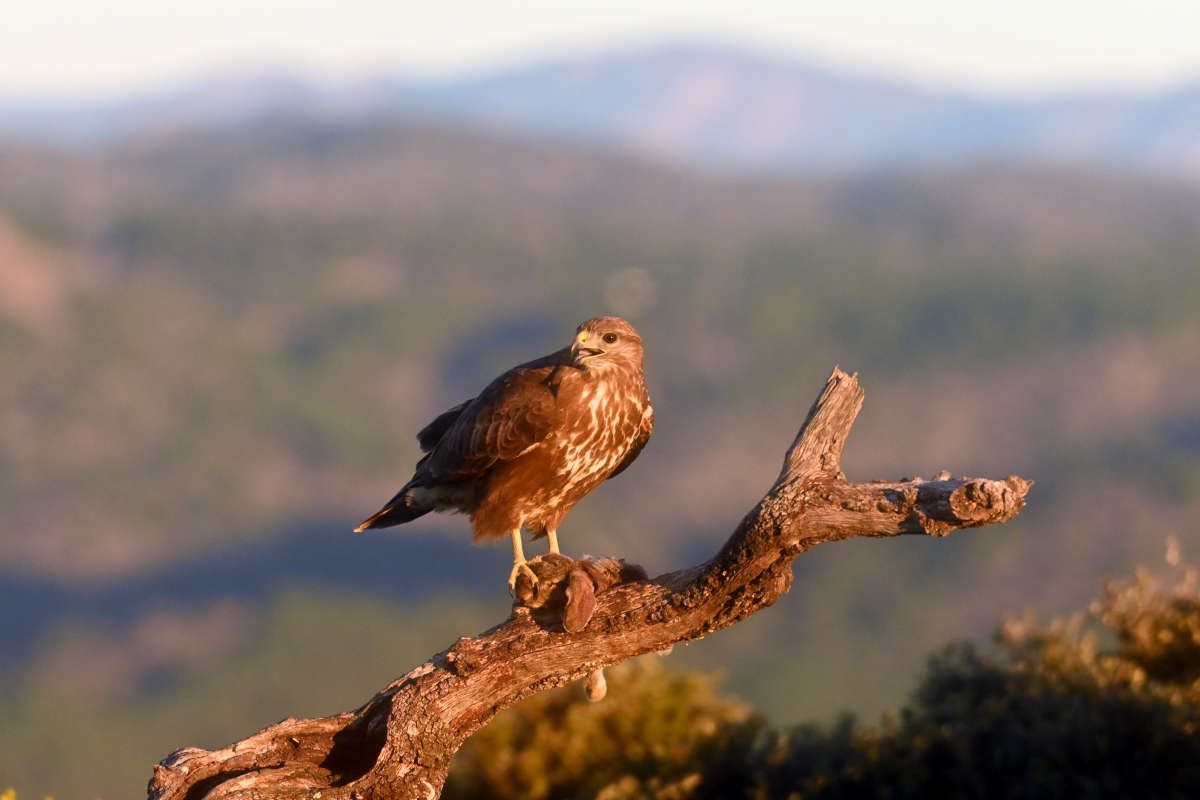
When we see it perched, it looks like a reddish-brown, slightly plump bird. In flight, what we see is completely different. A bird of prey with short, broad wings, a short, fan-shaped tail, and plumage in a wide variety of shades.
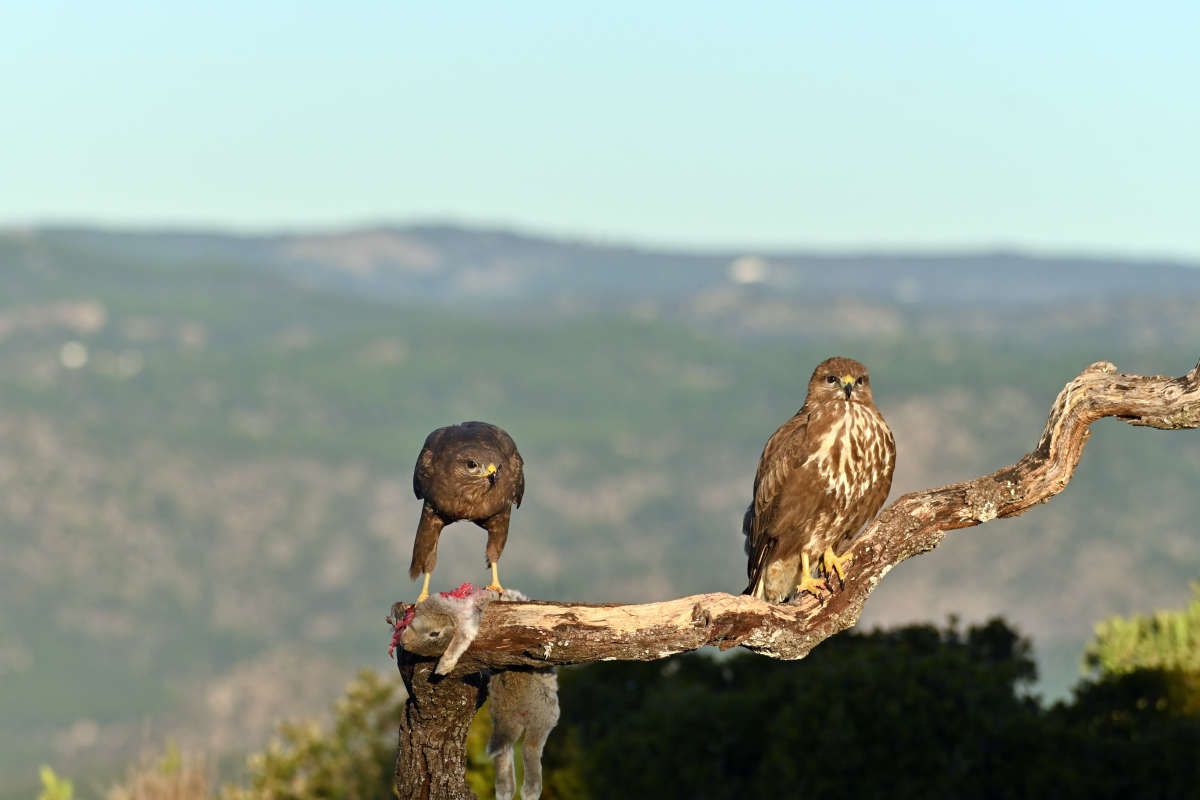
Their plumage can range from very light brown to extremely dark reddish. Adults have a more uniform brown color that contrasts with the breast feathers, which usually have white stripes of varying length in each individual.
Common buzzards are widely distributed throughout the Iberian Peninsula. Almost all pairs are residents of the Peninsula, that is, they do not migrate at any time, although we also receive couples from northern Europe who spend a milder and more comfortable winter here.
The Buzzards They are undemandingAll they require is some vegetation in which to nest. This is why they are so widespread across the Peninsula. They love wooded areas, but we can find them in both lowland and high mountains up to 1,600 meters. We also see them in plains and meadows, although their favorite habitat seems to be places that combine a bit of everything: wooded areas, meadows, and meadows. In winter, we can even see them in cultivated fields.

This is another key to their success. Common buzzards They are not fussy at all with its diet. From insects and worms to birds, reptiles, amphibians, small mammals, and even rabbits and even the carrion of other birds of prey. It's true that its diet varies greatly depending on the season, but it's also true that this wide variety of food sources has allowed it to establish itself in habitats and climates where other, more specialized birds of prey cannot.
The breeding season of the buzzard, like that of almost all birds of prey on the Peninsula, begins in the months of March and AprilThey first explore the area where they will build their nest, or reuse an old structure, and then lay their eggs between April and May.
Females usually lay eggs between 2 and 4 eggsAlthough the male helps with incubation, it's the female who spends most of her time in the nest while her mate goes out to find food for her. After 33 or 35 days, the eggs hatch, and the chicks remain in the nest for another 33 or 35 weeks, about 60 days. They then begin to experiment with short flights, although they still occasionally return to the nest.
Finally, by mid-summer, the chicks are ready to leave their parental territory and seek new hunting grounds.
Well, I'm afraid you're going to call me tiresome for repeating myself so much, but the main threat to the common buzzard, as with the rest of the Iberian birds of prey, is humans. Even so, its lack of specialization and its average size make it a a very versatile bird of prey, capable of adapting to different environments and media. Therefore, today, according to our friends at SEO Birdlife, the common buzzard is not included in the Spanish catalogue of threatened species.
The buzzard has always been pursued and shot by hunters, as it is a fierce competitor for smaller prey such as rabbits, partridges, etc. Even so Their populations in the Iberian Peninsula remain strong and stable. And only the modification of their natural habitat by humans, the disturbance caused by tourists during the incubation period, illegal hunting, collisions with power lines, or forest fires pose a real threat.
Friends, I hope you enjoyed this article about the common buzzard. Big hugs, and see you next time!