Hello friends,
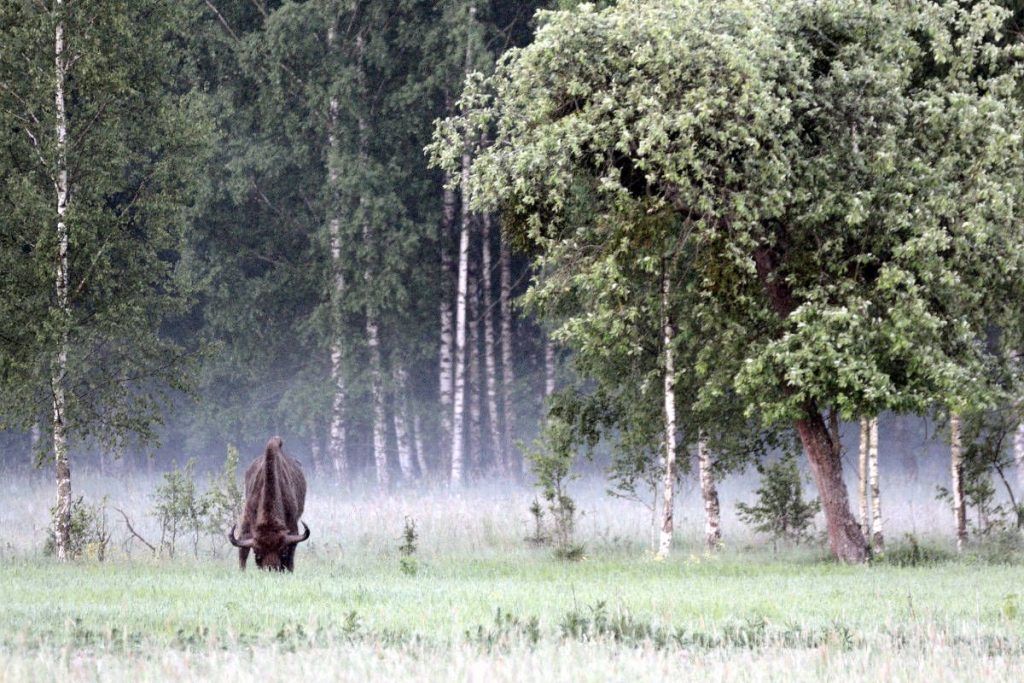
If someone asked me, "What did you do last weekend?" I don't think anyone would believe my story unless I presented some photographs as proof. The first weekend of June, I finally took the trip I had waited and dreamed of for so long: an impressive adventure chasing the largest land mammal on the European continent. Here's a post entirely dedicated to our photographic trip to the National Park of Bialowieza.
When I learned that in Poland there was a national park where not only had they achieved bring back to life a practically extinct species like the European bison, but also that more than 500 specimens had been released in the surroundings of the central core of the park (the area protected by UNESCO as a biosphere reserve) I knew that this precisely had to be the destination of my first trip within Poland.
I put you in the situation: The park It straddles the border of Poland and Belarus, so calling it national park This seems like the first absurdity to me. The second absurdity is that it has a physical border, a barrier, a barbed wire fence, that divides the park along the territorial boundary. legal from both countries... because let's remember that Poland is part of the EU (and the Schengen Area), while Belarus... well, it isn't. Have you heard the expression "putting gates to the field"? Well, in this specific case, there are not only gates dividing the park, but also borders, fences, and in some places, even border police.
So not only bison, but also deer, roe deer, wild boars, beavers... all of them require special permission to cross the border. In fact, there are many jokes among Poles about the swine fever caused by Belarusian wild boars. Do you remember the swine fever that emerged a few years ago in Spain? Imagine the same case on a Schengen border formed by an international biosphere reserve, which has the highest status of the UN and UNESCO... in other words, a diplomatic nightmare caused by wild boars.
The park has a core Virtually forbidden to humans, for more than 70 years, the original forest has been allowed to grow without fencing, pruning, removing wood or dead animals... that is, within this central core, the park is protected from any human action (agriculture, livestock farming, or construction of social housing) and is only accessible to researchers and a certain number of tourist visits to certain areas controlled by video surveillance. To give you an idea, they force you to urinate outside the controlled area because any human deposit is prohibited inside.
Thus the visitor can appreciate what the original forests that stretched across Europe thousands of years ago. Calling it a forest might confuse a Molina resident (like me) accustomed to a pine forest. In this case, the primeval European forest is a kind of swamp covered in trees (some almost 600 years old), shrubs, fungi, algae, and all sorts of insects and mosquitoes... along with the park's main and most feared predator: the tick.
I'm not a great botanist, but I am a fan of four-legged creatures. The evening before our search for the extinct animal, I ran a couple of tests with the goal of telezoom and the camera to check its response speed, if the "anti-shake" system was acceptable (a telephoto lens like that causes a lot of shaking problems) and if it produced good photos..... judge for yourselves.
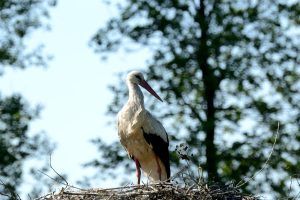 I took several photos like this one at the house we were staying in. I especially love this photo because of how clearly I captured the stork and the bokeh effect which can be seen in the trees behind. A characteristic of telephoto lenses is that they compress the focal length of the image, creating an effect in which the main subject and the background appear close together, when in reality they are not. The distance between the stork and the trees in the background is about 500 meters. However, in the photo, it doesn't seem so far away, and the trees appear blurred, out of focus... that's the bokeh effect.
Once we'd tested the lens in the field, we settled in for a couple of hours of sleep. I was excited about the prospect of seeing animals almost unique in Europe. Still, getting up during hunting hours to hunt for animals that can weigh twice as much as a fighting bull was tough, very tough.
We were up and about at 2 a.m. At 3 a.m., we met a local guide who drove us through the forest, passing several villages and plains. on the hunt of the bison. After all this long windedness, you'll probably be wondering if we managed to "hunt" some bug... well...
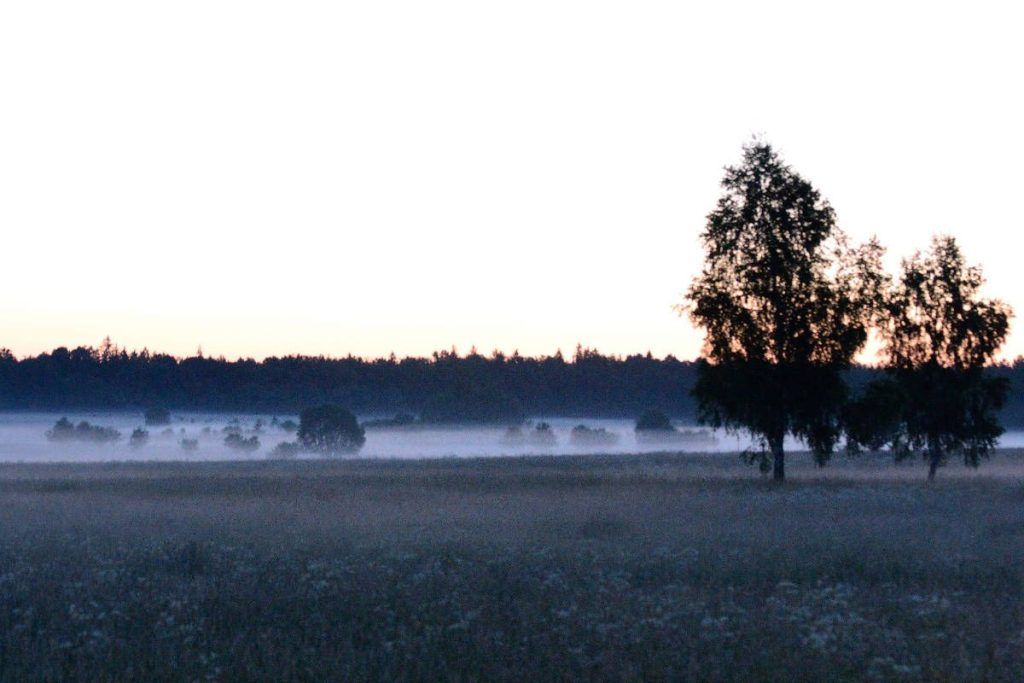
It's 4 a.m. and dawn is breaking on the border between Poland and Belarus. Suddenly, through the mist, I glimpse some strange shapes... I take out my camera, focus, shoot, and... shit... bushes.
 I still keep shooting. The light at dawn is fantastic and it will also serve as proof; when I get to the capital, people won't believe what a piece of early morning We've been trying to find bison. By the way... where the heck are the bison hiding? I'm sure the guide has ripped us off...
Suddenly, someone in the group points out my mistake. I'm looking for bison on my right and it didn't even occur to me to look to my left. When I turn 180 degrees on my heels, I suddenly find a small shack for storing farm implements, and right next to it...
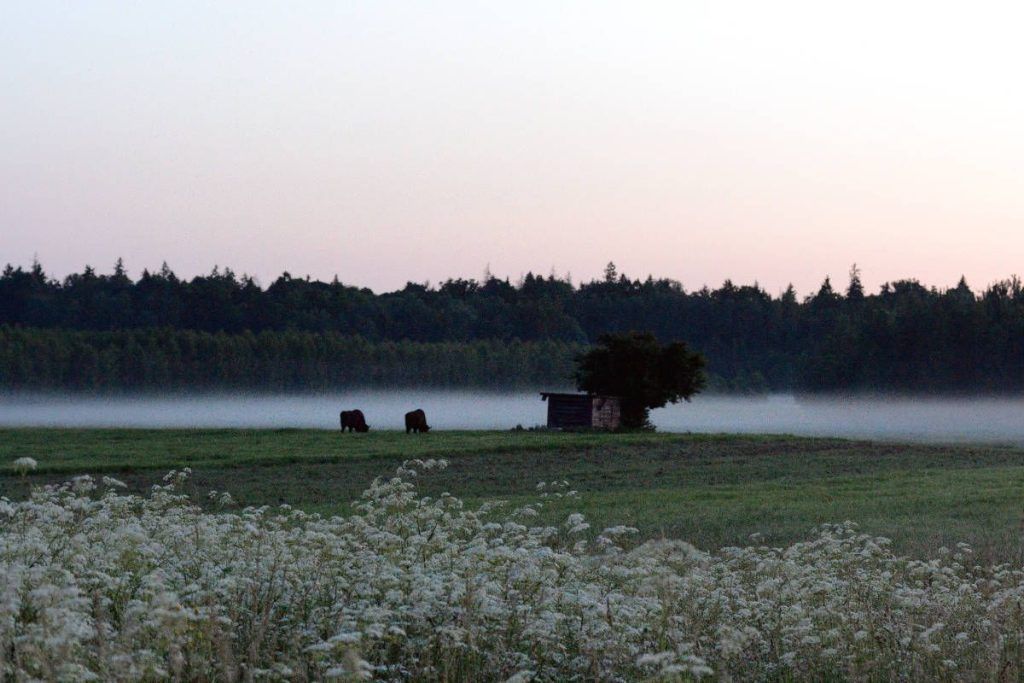
CRAP! Are those the bugs? Are those the bison? They sure look like very large cows... too large... I adjust the zoom on the lens and shoot again, only to find that... shit, I'm still too far away from them.
At that moment, I turn, smiling, to the group with me, thinking the typical retired firefighter idea: "Guys, wait here while I get a little closer." When I catch a glimpse of the group, I see the guide we hired setting up a 500mm lens, and I'm suddenly overcome with the healthy envy of a little kid who sees another kid at the park with a better toy. CRAP, CRAP, CRAP! My 300mm is nothing at this distance. I need a 500mm... in fact, I ALREADY KNOW what I want as a Christmas present... a 600mm.
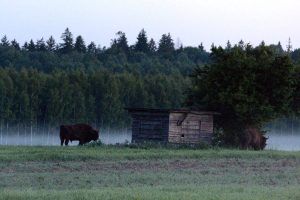 Still, I try to get a little closer... just a little closer. Suddenly, I realize the absolute silence that surrounds such large animals... they are simply grazing... I would love to hear the sound they make when they bleat, snort, bray, or chirp... whatever they do... I've never heard the sound a bison makes... The guide explains to me that in September and May they "baa" during their mating season, like deer... I've never heard cows do that... do cows do that?
"A little closer, Apa, just a little closer..."
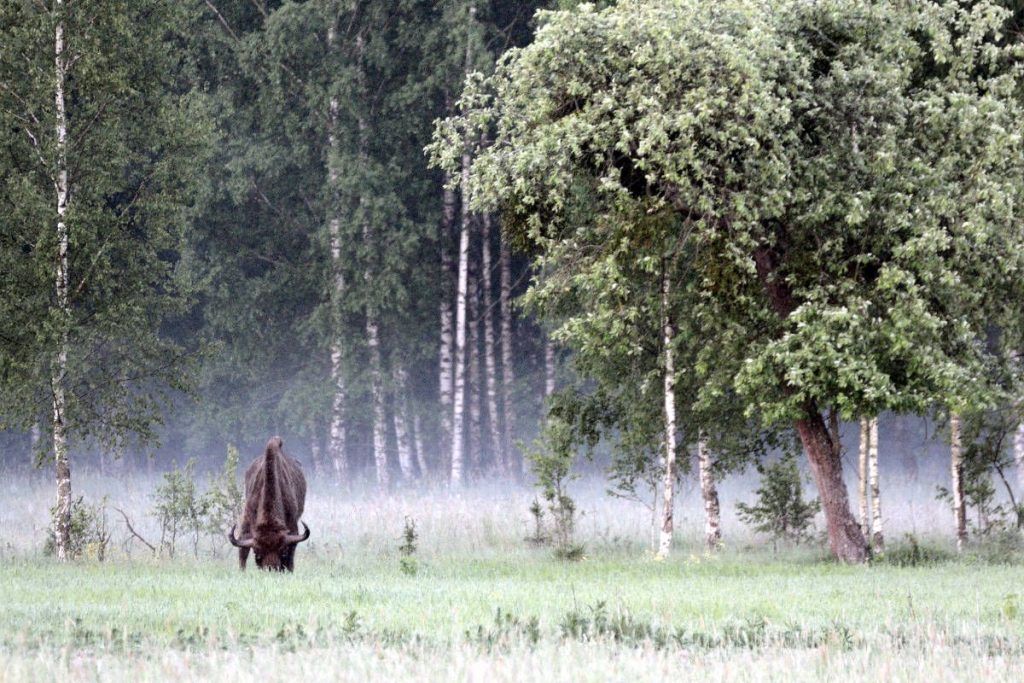
Okay, we're getting better... but wait a minute... what's that wet feeling? CRAP! With the foolishness of getting closer to the bison, the lack of coffee in my bloodstream, and the hours of owl-watching... I hadn't realized I'd stepped into a mudhole to get closer to the animals. My feet are soaked with water, and I think the boots that covered 500 km of the Camino de Santiago with me have become waterlogged. At that moment, another phrase someone had said to me a few days earlier flashes through my mind. "The worst predator in the park is the tick."...and I'm up to my knees in mud, my toes splashing... Well, since I'm here, one more photo won't hurt...
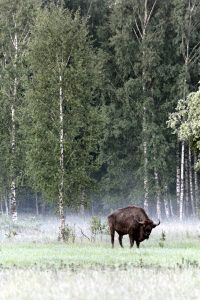 And that's as close as I got to a bison in the wildOf course, there's an area within the park that's been converted into a zoo where we can see captive bison, closer, more motionless... less lifelike. We can also see some specimens at the Warsaw Zoo... but nothing compares to the feeling of being in front of a beautiful animal in the wild, one that almost became extinct years ago due to the excessive hunting of kings and tsars (yes, back then there was also the equivalent of our Juan Carlos I).
I have more photos of the park, of other animals, of some ancient trees, of water activities, of certain lakes in the region, and even of an extermination camp that we crossed on our way back to civilization (curious to associate "extermination" and "civilization" in the same sentence after abandoning such a rich natural area protected from humans). I have many more photos, almost 300... but those photos will have their place in another time, in another article, and in another story. In this article, I just wanted to talk about bison, bison and more bison. Talk about the recovery of nearly extinct animals. Talk about how stupid humans can be (most of the time) and how intelligent they rarely are. Talk about how necessary spaces like this natural park are, isolated and removed from human activity, precisely so that humans can understand and learn what these natural spaces are like.
Friends, I know this has been the first of many visits and photographic getaways that I will do to the national park of BialowiezaThe experience of getting up close to these almost magical animals that roam freely in the park and being able to observe their behavior while photographing them was an unforgettable moment that I will treasure, just as I treasure the memories of all "firsts." I hope to return to the park in the winter to see the contrasts and behavior of the animals in such extreme weather.
Friends, a big hug and see you next post.