Hello friends,
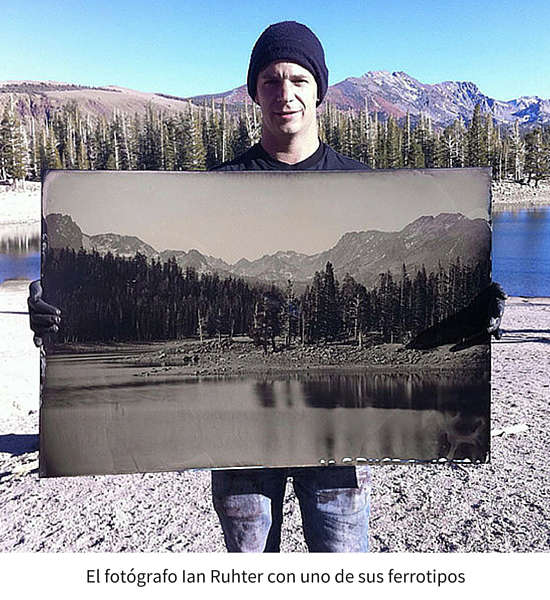
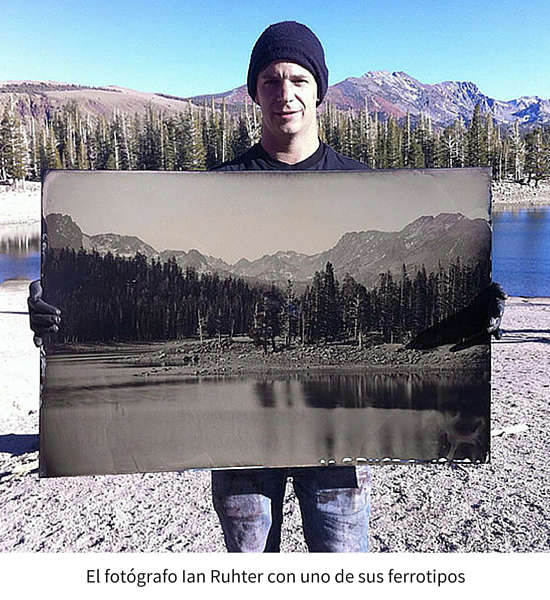
Anyone who enjoys digital photography has been interested in the history of this art form at some point. How and when it was born, the different techniques, formats, and materials used, and how they have evolved over time. Surely some of you, like me, have been interested in chemical photography (misnamed analog) and have come across a spectacular project by a photographer who some time ago decided to work with tintypes.
The moment I saw this video, I fell in love with the project. Ian Ruhter. Perhaps it's because of my background in chemistry, perhaps it's because of the romanticism that permeates all types of photography. old-fashioned, or perhaps because of my fondness for the series Breaking Bad (""Bromo Ba(River" for those who like to summarize). I love the idea of moving away from the digital world in the 21st century to portray the landscape of the USA (and its inhabitants) as it was done a century ago. But what amazes me most is the size of the camera Ian Ruhter uses: THE CAMERA IS A TRUCK.
What does his project consist of? Ian Ruhter's photographs are known as tintypes. I imagine everyone remembers those old bellows cameras, where the photographer hid under a black cloth to prevent the photographic plate from being exposed. Nowadays, we're so accustomed to the digital world that we may not fully grasp the old process of chemical photography. The idea is that light shines (through a glass lens) onto a surface (the support) coated with a photosensitive substance.
In the specific case of the tintype, the photographic support is a metal plate painted black. This plate is first coated with a mixture of ether and alcohol (known as collodion solution), an emulsion onto which a mixture of silver nitrate and other salts, the substances that are actually photosensitive, is then fixed.
And here comes the complex part of the process. Ferrotype (known in English as wet plate photography) cannot be allowed to dry. The photograph must be taken just minutes after the metal plate has been coated with the photosensitive mixture. This means that the plate must be coated in complete darkness to avoid accidental exposure (or fogging). Afterward, the photographic plate is placed in the camera, the shutter is opened (the lens cap is removed), and the plate is exposed to light for several seconds. Finally, and still in complete darkness, the plate is coated with different mixtures of solutions that stop the photosensitive process and fix the image on the plate.
In short: imagine we replace our brand-new digital cameras with one of these old cameras. The process to follow (half of it in the dark) to take a single photograph (there's no possibility of deleting or retaking) would be:
All of this is to obtain a single image. As I said, there's no way to delete it or repeat the process with other settings (more or less exposure time, greater or lesser focal length...) unless we prepare another metal plate from scratch.
Logically, the process is more complex when we use a truck as sounding board Photographic. With an old bellows camera, the process might be a little simpler (though not by much). You can judge for yourselves in this video:
Of course, a camera like the one described above only allows us to take photographs of a size determined by the plate holder. However, photographer Ian Ruhter can take photographs on metal plates of varying sizes, thanks to his larger "camera truck." Therefore, his photographs, both landscapes and portraits, are fantastic for exhibition in art galleries and museums.
Friends, this project has really touched me, so much so that I've already added Ian Ruhter's personal website to my favorites. I hope you like it as much as I do. I'm convinced that those of us who come from the world of chemistry and tinkering in the lab have fallen in love with this project at first sight.
Hugs and have a happy start to the week.