
Hello friends,
in some of our trips We have missed the little help that the focal multipliersOver the past few weeks, I've had the opportunity to test and experiment with one of these multipliers. Would you like to know the advantages and disadvantages of this accessory?
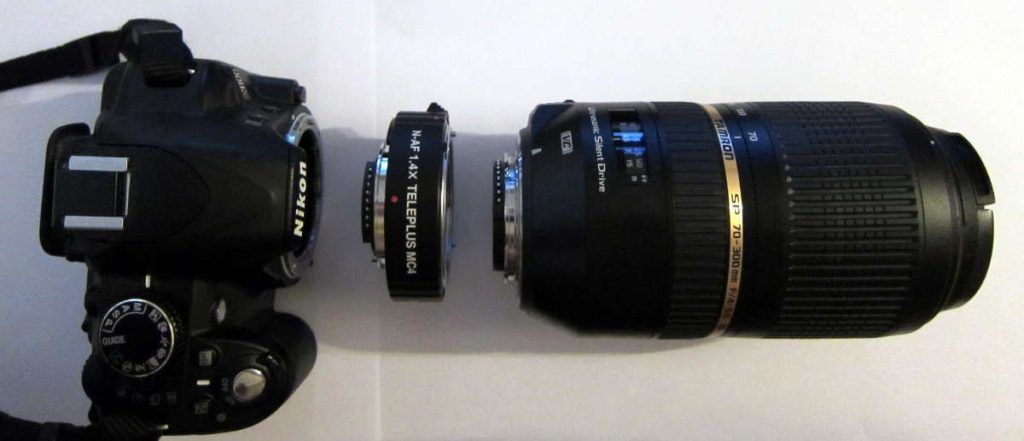 What are focal multipliers?
A multiplier either focal converter It is nothing more or less than a kind of double lens that is inserted between the camera and the lens. In a previous article We have already talked about the possibility of changing the focal length of our lenses with different accessories, lenses, extension tubes and focal length multipliers.
The latter, the multipliers, are the most developed and complex and, as you can understand, the most expensive of the accessories mentioned. Even so, they are an economical option if we already have a short telephoto lens and we can't afford to make a big investment in a big, fast telephoto lens (which can cost as much as a car).
If we talk about the two brands par excellence canon It has 1.4x and 2x multipliers, while Nikon markets 3 types, 1.4x, 1.7x and 2x. The graduation refers to the multiplication factor of each of them: from those that multiply the focal distance by a factor of 1.4 up to those that double the focal length (2x).
Nowadays, we can find other, cheaper brands on the market that sell different focal length extenders for Canon and Nikon. These brands tend to be the most popular among amateurs, as they offer a decent focal length extender for a reasonable price.

The main advantage is clear: for a price 5 or 6 times cheaper than a large (and bright) telephoto lens, we can extend (or even double) the focal length of our short telephoto lens. They are normally used with inexpensive lenses with a maximum focal length of 200 mm or 300 mm. This will allow us to convert these lenses into telezoom up to 600 mm if we use a 2x duplicator.
This doesn't mean that there aren't good (and expensive) extenders that professionals use with good (and expensive) telephoto lenses, but normally, a good professional will prefer (and be able to) invest much more money in a big, bright telephoto lens than in an extender... why?

There are two major disadvantages that can dissuade a professional: the loss of brightness and the loss of quality. By inserting a converter between the lens and the camera sensor, the diaphragm opening. The multiplication factors 1.4x and 1.7x decrease light by 1 stop (one f-stop), while the factors 2x decrease light by 2 stops. This will force us to adjust other parameters such as ISO or shutter speed to obtain a correct image. exposed.
Another disadvantage is the loss of autofocus (AF), which can occur when combining older models of extenders, lenses, or both. Older lenses combined with extenders can lose autofocus starting at f/5.6 or f/8. Newer models avoid these problems up to higher aperture values, as each new product introduced to the market improves communication between lens and camera via the extender. However, this disadvantage is something we must take into account if we want to buy a secondhand extender or use it with an older lens.
How was my experience? Well, I have to say that despite the disadvantages, I was convinced by using the extender. I've already told you about my short telephoto lens (70-300mm). Combining this lens with a Nikon extender from the brand kenko (Teleplus N-AF 1.4x MC4) was a good decision. The 1.4x magnification factor turned my Tamron 70-300mm lens into a lens with an effective focal length of 100-420mm.
The perfect place to experiment with a zoom lens like this is a spot where we can keep a close eye on the subject we want to photograph. In this case, I decided to test the zoom lens on one of our visits to the zoo. It's the perfect place. We have dozens of isolated subjects, at the right distance for using a telephoto lens, and they generally remain still while we attach and detach the converter.
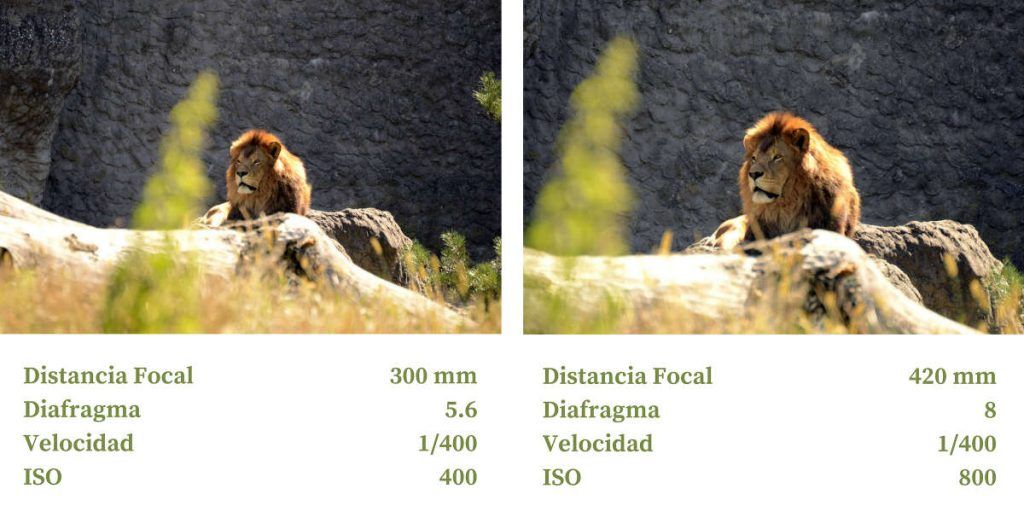
As I explained, using a multiplier increases the effective focal length of the lens (in the case of the Lion, from 300 mm to 420 mm) by decreasing the light input by 1 stop (going from an aperture of 5.6 to an aperture of 8). In this case, we have to change some of the basic parameters, such as the ISO or shutter speed.
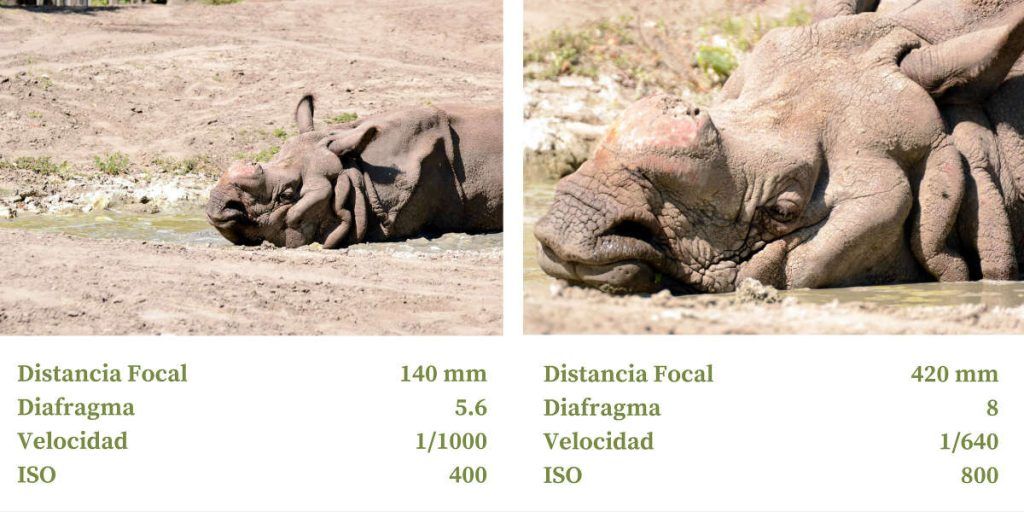
Sometimes the zoom factor allows us to take impressive close-up photographs, as in this extreme close-up of a rhinoceros. With an effective focal length of 420 mm, we can perfectly appreciate all the details of this fantastic animal's head.
My overall assessment after several tests is that it's worth combining a short telephoto lens with a zoom lens. We won't always need to use it, but it will add a plus when we need it. I preferred to experiment with a 1.4x zoom lens and lose only 1 stop of light, rather than trying a zoom lens and losing 2 stops of light from an already dim lens.
In my particular case, as a wildlife photography enthusiast, I can say that the focal length multiplier can become an essential tool in my backpack when I plan to work with large mammals or bird photography.
I don't want to say goodbye without giving a couple of additional tips. NOT ALL Focal length multipliers are compatible with all lenses or SLR cameras on the market. And it's not just a matter of electronic communication (autofocus), but also of physical compatibility. Many converters from budget brands may be physically incompatible with budget lenses, so we can't assemble or connect them. Sometimes the lenses of the converter and the lens can collide in the same physical space. Of course, if we decide on a Nikon or Canon converter, it will be compatible with our Nikon or Canon lenses. But combining budget brands of lenses and multipliers is more complicated.
It's a good idea to compare as much information as possible before purchasing a multiplier. We can find a wealth of information online about our lenses and the brands of multipliers that are compatible with them. Photography forums and Facebook groups are always a source of helpful advice from other photography enthusiasts.
Friends, I wish you a good start to the week.
All the best.